
Quantum-Safe Personal Wallets: The "Post-Quantum" Shield
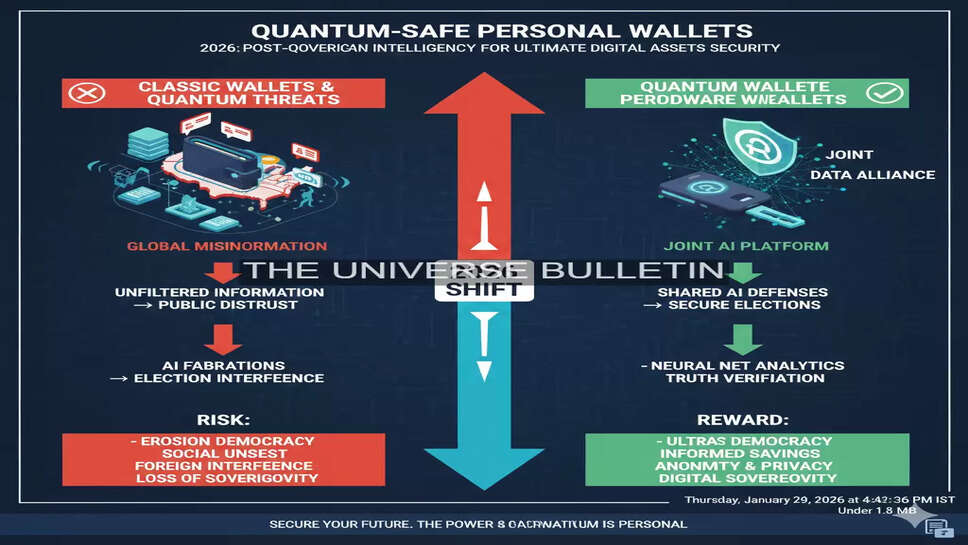
The 2026 "Quantum-Resistant" Architecture
The 2026 hardware wallet is a "Hybrid" machine, combining the best of legacy security with the new frontier of PQC.
-
Dual-Signature Workflows: In 2026, most quantum-safe wallets use a Hybrid Signature Model. Every transaction is signed with both a traditional ECDSA key (for backward compatibility with current blockchains) and a PQC key (for future-proofing).
-
Tamper-Resistant Secure Enclaves: The 2026 QS7001 Post-Quantum Secure Chip features a specialized "Neural Enclave" designed to handle the larger key sizes and heavier computational load of lattice-based algorithms without draining the device's battery.
-
Crypto-Agility Firmware: 2026 wallets are no longer static. They feature "Crypto-Agile" firmware that allows users to swap algorithms via secure updates as NIST continues to refine standards like Falcon or SPHINCS+ throughout the year.
2026 Security Snapshot: Legacy Wallets vs. Quantum-Safe Wallets
| Feature | Legacy Hardware Wallet (2024) | Quantum-Safe Wallet (2026) |
| Primary Algorithm | ECDSA / RSA (Vulnerable). | ML-DSA / ML-KEM (Quantum-Safe). |
| Key Mathematics | Elliptic Curves / Prime Factors. | Multi-Dimensional Lattices. |
| "Harvest Now" Risk | High (Vulnerable to future decryption). | Low (Unbreakable by current/future QC). |
| Key Size | Very Small (~32-64 bytes). | Large (Kilobytes range). |
| Regulatory Status | Standard Consumer Grade. | FIPS 140-3 / NIST PQC Compliant. |
The 2026 "Q-Day" Preparation Economy
The 2026 launch of these devices is reshaping the "Cold Storage" landscape.
-
The Rise of PQ-Blockchains: By early 2026, networks like Algorand, The Quantum Resistant Ledger (QRL), and Hedera have fully integrated PQC support. Owners of 2026 hardware wallets can now move their assets to "Quantum-Safe Addresses" that use Dilithium signatures by default.
-
Sovereign Wealth Protection: In 2026, high-net-worth individuals and family offices are leading the migration to quantum-safe hardware. The fear of "Institutional Decryption" by state actors has made PQC hardware the standard requirement for any portfolio exceeding $1M in digital assets.
-
The "Seed Phrase" Evolution: 2026 wallets are introducing PQC-Entropy Seed Phrases. These are enhanced recovery phrases that use quantum-resistant hash functions (SLH-DSA) to ensure that even the "master key" recovery process is immune to Shor’s algorithm.
Conclusion
The 2026 release of Quantum-Safe Personal Wallets is the tech industry’s preemptive strike against the greatest cryptographic threat in history. By embedding Post-Quantum Cryptography into the palm of your hand, these devices have turned the "Quantum Threat" from a looming disaster into a manageable technical transition. As we move through 2026, the question is no longer if you will be targeted by a quantum computer, but whether your "vault" was built before or after the 2026 PQC revolution. In 2026, your digital sovereignty is only as strong as the math protecting it.
FAQs
Will my current "seed phrase" work with a 2026 quantum-safe wallet?
Yes, but for full quantum resistance, 2026 wallets encourage a "Migration Event" where you generate a new PQC-based seed and transfer your assets to a quantum-resistant address.
Does this mean current Bitcoin is "broken" in 2026?
No. A quantum computer powerful enough to crack Bitcoin's ECDSA is still years away. However, 2026 is the year most experts recommend starting the migration to prevent "Harvest Now, Decrypt Later" attacks.
Are 2026 quantum-safe wallets more expensive?
Slightly. Due to the advanced QS7001 or RISC-V chips required to process lattice math, 2026 PQC wallets typically retail for $149–$199, roughly 30% more than legacy models.
How do I know if a 2026 wallet is actually "Quantum-Safe"?
Look for NIST FIPS 203/204 compliance and "Hybrid Support." A true 2026 quantum-safe device will explicitly list its support for ML-KEM and ML-DSA algorithms.
Can a quantum computer eventually break PQC too?
In 2026, PQC algorithms are based on "NP-Hard" problems that are mathematically resistant to both classical and quantum computers. While nothing is "infinite," these are the most secure structures known to modern science.